In telecom and fiber, AI is moving past copilots and analytics. It’s becoming embedded directly in operational decision-making — service qualification, pricing and promotional recommendations, retention actions, dispatch prioritization, outage workflows, care and support.
And in more and more environments, those recommendations are wired straight to execution. That’s where the governance challenge begins.
The architecture most organizations have built follows one simple pattern: AI generates an outcome, and operational systems act on it immediately. Often with no explainability, no risk classification, no approval boundary, no human validation, and no governance checkpoint in between.
That’s a dangerous gap. Because once AI-driven decisions run at enterprise scale, small issues compound fast across customer interactions, operational workflows, and revenue-impacting processes.
This is where we introduce the concept we’ve been developing at Crystal Eye: the Ethical Air Gap™.
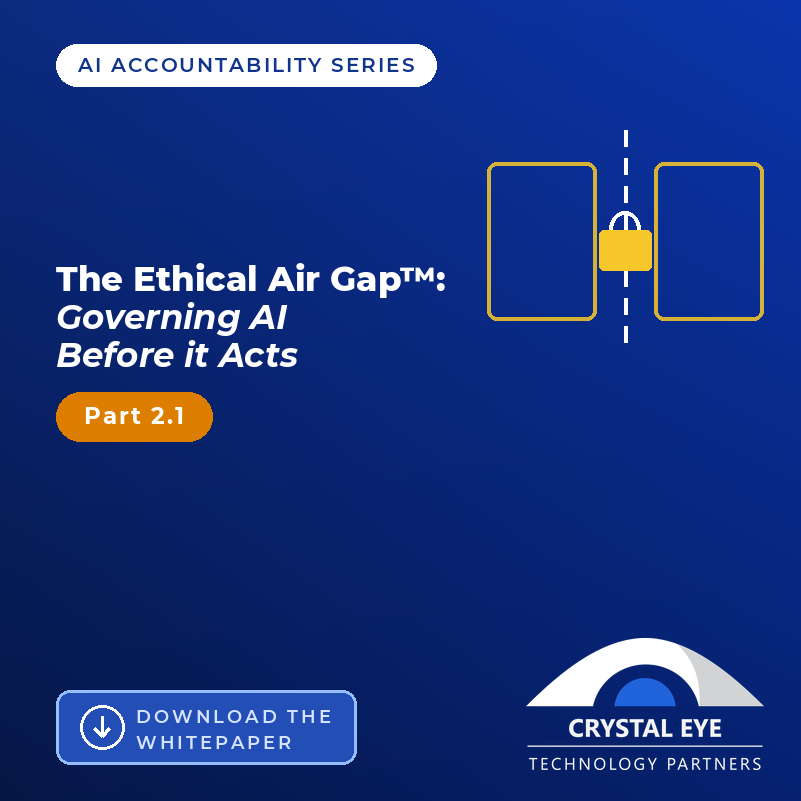
The Ethical Air Gap™ is a governance boundary that deliberately separates AI capability from autonomous execution. Its purpose is simple to state and hard to argue with: AI should not act without governance.
In practice, it’s an inline control that sits between the recommendation and the action, and returns one of three verdicts on every state-committing step — allow, hold, or deny. Not a review that happens after the fact, when the decision has already scaled. A checkpoint that happens before the system acts. It brings decision isolation, controlled activation, risk-based approval pathways, human oversight for critical decisions, and accountable execution.
In telecom, that matters enormously, because AI increasingly influences who receives an offer, how customers are prioritized, how outages are escalated, how care experiences are shaped, and how workflows execute. Without a boundary, you build an operation where decisions outrun accountability.
The point isn’t to slow AI down. The point is to keep operational AI explainable, governable, and aligned with enterprise accountability — while it moves at machine speed.
Because the future risk of AI isn’t what it knows. It’s what you allow it to operationalize.
Download the white paper
Enter your email and we'll send you straight to the PDF.